Building OpenLLMBuddy: Lessons From AI Infrastructure Chaos
Building OpenLLMBuddy: Lessons From AI Infrastructure Chaos
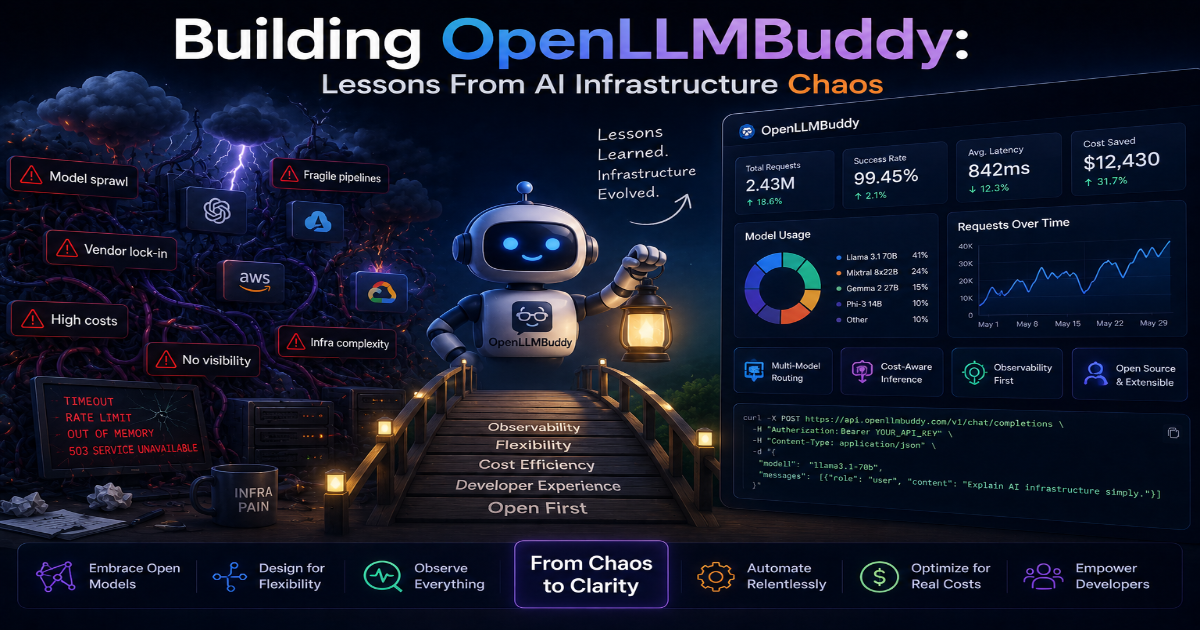
This is not a polished product announcement. It's a post-mortem on every infrastructure mistake we made, every budget we burned, and the specific frustrations that forced us to build something we couldn't find anywhere else.
1. The Day the Token Bills Broke Us
It started at 7:43 AM on a Tuesday.
I opened my laptop to a Slack notification from our billing system. $2,847. A single overnight API charge. From one background script.
We'd been building a multi-turn web-scraping and code analysis agent — the kind of recursive workflow where the model reads a repository file, identifies dependencies, fetches related files, re-evaluates, and loops. Exactly the kind of deep reasoning chain that produces genuinely useful output. We ran it before we went to sleep. By morning, the agent had looped through a 180,000-token codebase context 23 times, generating hidden internal reasoning traces on every pass, and our serverless API provider had quietly invoiced every single one of those tokens at full output rate.
Nobody warned us. No spending cap had triggered. There was no circuit breaker. Just a bill and a very quiet Slack channel at 7:43 AM.
That was the moment I understood what Token Anxiety really is. It's not just financial stress — it's the invisible architectural constraint that shapes every prompt you write. I started catching myself shortening system prompts not because shorter was better, but because I was afraid of what the context window would cost. I started avoiding deep multi-step reasoning chains that would have produced better outputs because the thinking tokens were too expensive. Our engineers started doing the same thing without anyone agreeing to it — a collective, unspoken self-censorship driven entirely by per-token pricing.
When the cost model of your infrastructure starts shaping the quality of your engineering decisions, the infrastructure has already won. And not in your favor.
We cancelled two planned features that month. Not because they weren't good ideas. Because we couldn't afford to run the inference loops they required.
2. Descending into AI Infrastructure Hell
The obvious answer seemed straightforward: stop using proprietary APIs. Move to open-weight models — Gemma 4, Qwen 3.6 — and host them ourselves. Escape the token prison by owning the hardware.
I've never been more wrong about something being obvious.
The MoE Routing Nightmare
We started with Gemma 4 26B-A4B. The Mixture-of-Experts architecture looked like a gift — 26B parameters worth of reasoning depth, but only 3.8B active parameters per forward pass. Efficient at inference. Fast on a single GPU.
In theory.
In practice, orchestrating a 128-expert MoE architecture under concurrent load is a different problem entirely. The routing layer has to dispatch each token to the correct expert subset with low latency. Under load, with multiple agent processes calling the model simultaneously, the routing overhead compounds. We watched latency climb from 800ms to 4.2 seconds on P95 requests during concurrent load tests — not because the GPU was saturated, but because the expert routing layer was queuing.
The vLLM configuration to stabilize this was not simple:
vllm serve google/gemma-4-26B-A4B-it \
  --tensor-parallel-size 2 \
  --max-model-len 131072 \
  --gpu-memory-utilization 0.90 \
  --enable-chunked-prefill \
  --max-num-batched-tokens 8192 \
  --disable-log-requests \
  --max-num-seqs 32
Two GPUs in tensor parallel. Chunked prefill enabled. Sequence concurrency capped. And this was the stable configuration — after three days of tuning and a small mountain of failed test runs.
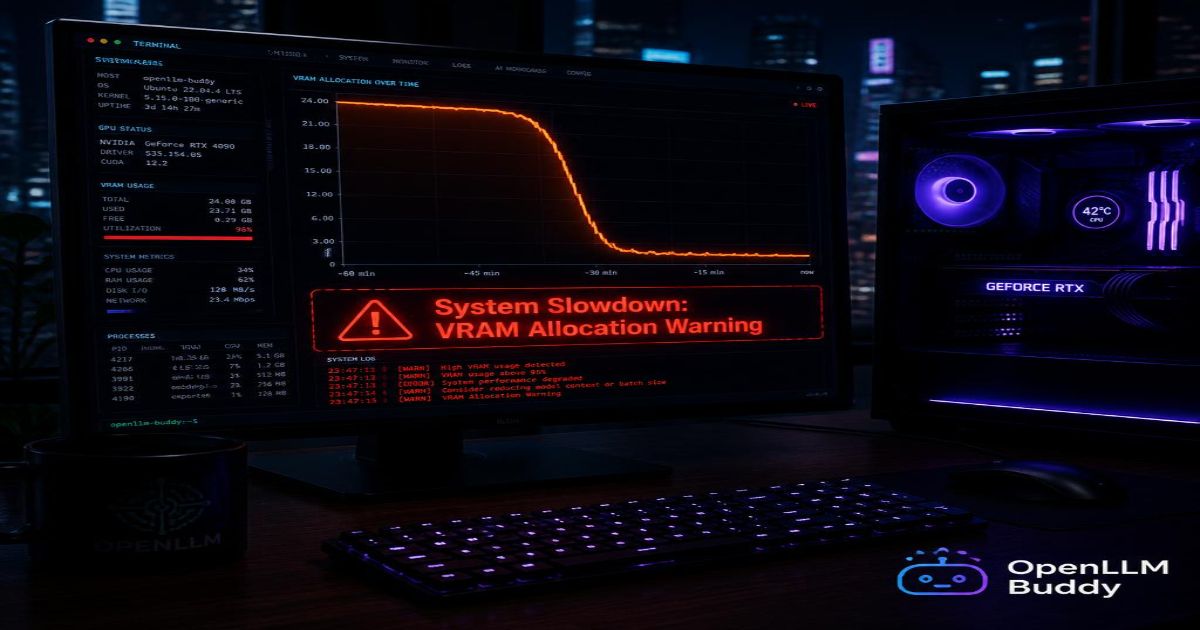
The VRAM Idle Bleed
We rented two A100 instances on a raw cloud provider. Premium hardware, premium price. Our agent traffic wasn't uniform — heavy during business hours, nearly zero between midnight and 6 AM.
During those six quiet hours, we were paying full hourly rates for two A100s to sit idle, loaded with model weights, serving zero requests.
We tried auto-scaling. The cold-start latency to load Gemma 4 26B from storage to a warm GPU took 45–90 seconds — completely unacceptable for any user-facing latency SLA. So we kept the instances warm. And kept paying for six hours of idle silicon every night.
At $3.20/hour per A100, six idle hours per night across two instances = $38.40/day = $1,152/month. Pure waste. That's two junior developer salaries going to GPUs that were literally doing nothing.
The OOM Wall
The OOM errors were the most demoralizing part.
Every time we pushed context length toward the model's 256K ceiling, or hit a concurrent request spike, the process would die with an out-of-memory error and require a full restart. The KV cache for long-context requests is enormous — and we hadn't correctly budgeted VRAM between the model weights, the KV cache, and the activation memory for concurrent sequences.
We implemented a basic health check and auto-restart script:
import subprocess
import time
import requests

def check_vllm_health(endpoint: str = "http://localhost:8000/health") -> bool:
    try:
        r = requests.get(endpoint, timeout=3)
        return r.status_code == 200
    except Exception:
        return False

def restart_vllm():
    subprocess.run(["systemctl", "restart", "vllm-server"], check=True)
    time.sleep(60)  # wait for model reload

while True:
    if not check_vllm_health():
        print("vLLM health check failed. Restarting...")
        restart_vllm()
    time.sleep(30)
A watchdog script to restart our inference server. We were three engineers building a product and one of us was maintaining a watchdog loop.
We tried to escape token billing, only to land straight into DevOps purgatory. We spent 80% of our time wrangling inference configurations, scaling rules, and cluster health instead of actually writing application code.
3. The Architecture of OpenLLMBuddy — One-Click Predictability
We didn't set out to build an infrastructure platform. We set out to build AI-powered products. But the infrastructure problems we kept solving the hard way were the same problems every developer hitting the open-weight ecosystem was running into.
So we packaged the solutions.
OpenLLM Buddy is the abstraction layer we wish had existed. It sits between raw RunPod compute and your application code, handling everything we spent three months fighting manually.
What We Automated So You Don't Have To
vLLMconfiguration — the tensor parallel settings, chunked prefill tuning, andKVcache allocation are pre-optimized per model variant. You don't touch a config file.MoEexpert routing — the 128-expert dispatch layer forGemma 4 26BandQwen 3.6 27Bis managed at the platform level. Concurrent requests don't compound routing latency.- Cold-start mitigation — instances are kept in a warm-ready state within your uptime quota window. No 90-second load delays.
OOMprotection —KVcache allocation is pre-budgeted against the hardware profile. Long-context requests don't kill the process.- Auto-termination — when your uptime quota expires, the instance terminates cleanly. No idle overnight billing. No surprise charges at 7:43 AM.
The Hardware
We run on NVIDIA RTX 4090 (24 GB VRAM) and next-generation RTX 5090 clusters via RunPod compute. The 4090 handles Gemma 4 26B at Q4_K_M cleanly — 112 tok/s throughput, sub-2s time-to-first-token at standard context lengths. The 5090 carries Qwen 3.6 27B at higher precision for workloads that demand it.
The End of Token Billing
The paradigm shift is simple: tokens are free, compute is not.
We charge for the GPU runtime — the minutes of silicon that actually execute your workload. We don't mark up the tokens your model generates or thinks. We don't charge extra when your agent runs a 10,000-token reasoning chain. We don't meter your context window.
Your $2,847 overnight surprise invoice becomes a $22 flat 24-hour block regardless of how deeply your agent reasoned.
4. What We Learned and Where We're Going
The hardest-earned lesson: developers don't want to think about VRAM math. They don't want to tune --gpu-memory-utilization or debug why their P95 latency spiked when concurrent requests hit 8. They want a fast, reliable, OpenAI-compatible endpoint that returns correct output and doesn't penalize them for building ambitious things.
The endpoint we shipped is this simple:
import openai

# Our battle-tested, token-free production endpoint
client = openai.OpenAI(
    base_url="https://api.openllmbuddy.cloud/v1",
    api_key="OPENLLM_BUDDY_INFRA_KEY"
)

response = client.chat.completions.create(
    model="gemma-4-26b-a4b",  # or qwen-3.6-27b
    messages=[{"role": "user", "content": prompt}],
    temperature=0.1
)
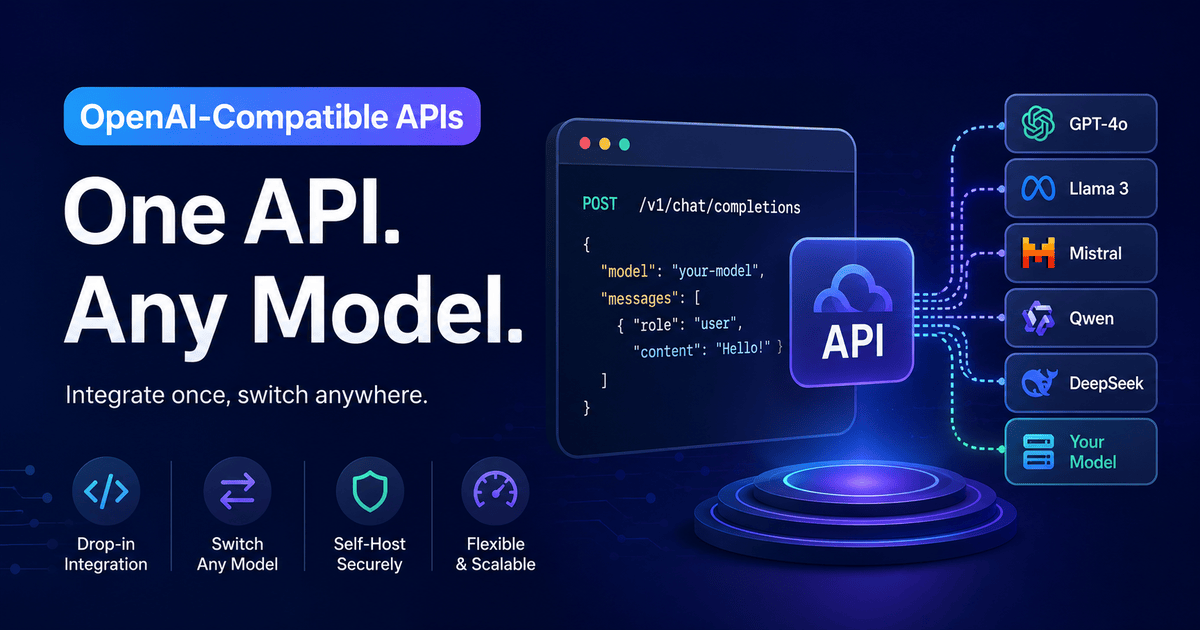
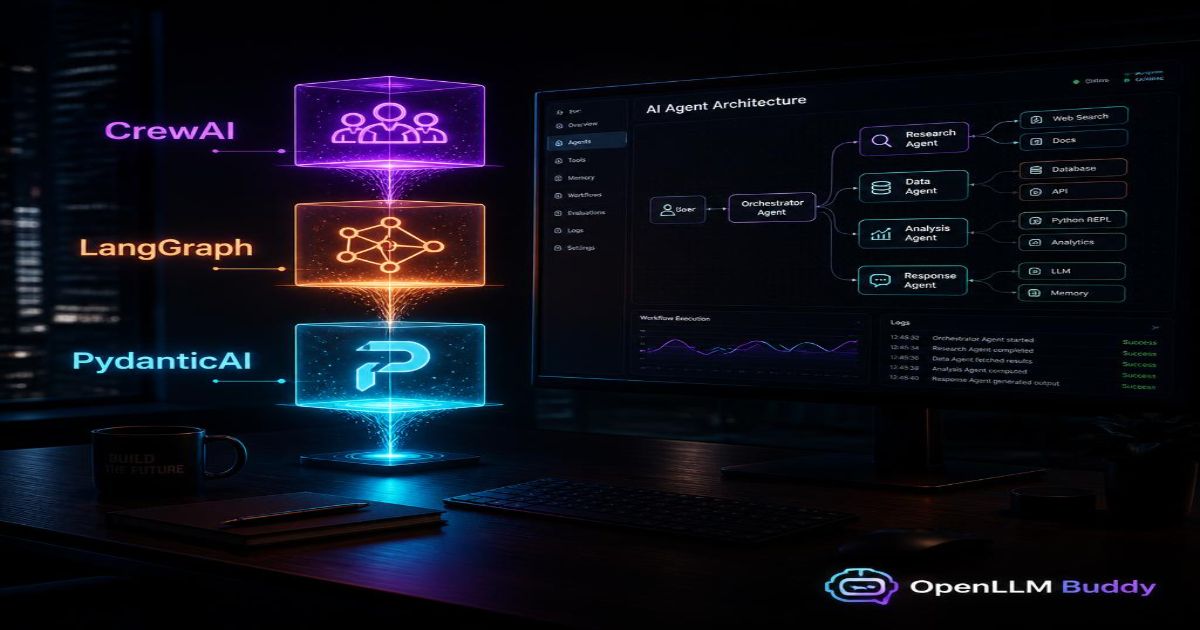
That's it. Drop it into LangChain, CrewAI, n8n, or your own FastAPI backend. The entire MoE orchestration, KV cache management, and cold-start handling is invisible to you — because it should be.
We're actively expanding model availability and hardware tiers. More models, more precision options, longer context configurations. The roadmap is driven by the same thing that started this entire project: building the infrastructure we needed and couldn't find.
If you've ever woken up to a token bill that made no sense, or spent a sprint debugging vLLM instead of shipping features — OpenLLM Buddy was built for you.
Try it. Your first context loop is on us.