Token Anxiety Is Real: Why Teams Are Moving to Open Models
Token Anxiety Is Real: Why Teams Are Moving to Open Models
You're three weeks into building a new AI feature. The prototype is working. The team is excited. Then your CTO forwards you the cloud bill with a single line: "Can you explain this?"
$4,200. One month. A background agent loop nobody remembered to cap.
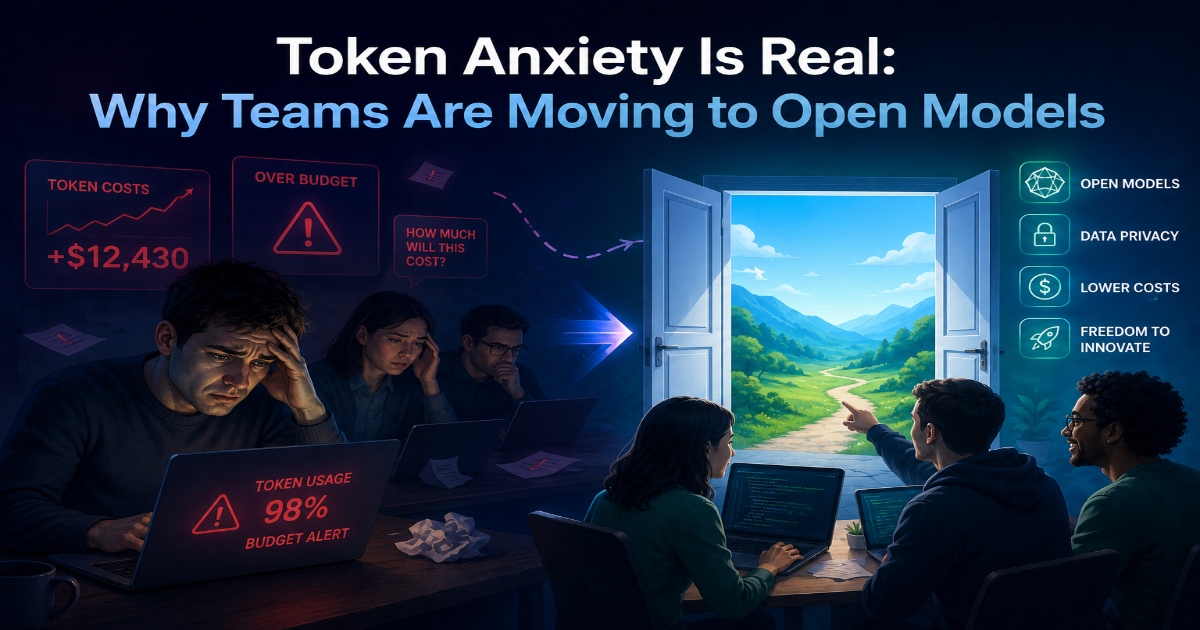
That feeling has a name. Token Anxiety. And it's quietly killing innovation at engineering teams everywhere.
1. The Psychology of the Metered API
Token Anxiety is the low-grade psychological dread that sets in the moment you start building seriously with a closed AI API. It's the awareness — always running in the background — that every single prompt, every recursive agent loop, every codebase refactor is chipping away at your budget in real-time.
It didn't used to be like this.
When you ran a compute-heavy process on traditional server infrastructure, you paid a flat monthly rate for your instance. A loop that ran 10,000 times cost the same as a loop that ran 100 times. You could experiment freely. You could test edge cases without mentally calculating a dollar amount per iteration.
The modern AI API era broke that contract.
A single runaway background script. A context window that grew faster than expected. An agent that looped 500 times instead of 5. These aren't hypothetical catastrophes — they're Tuesday morning incidents that have wiped monthly budgets in under eight hours.
The behavioral changes this creates are subtle but corrosive:
- Developers artificially truncate context windows to save on input tokens, directly degrading output quality
- Engineers write shorter system prompts — not because shorter is better, but because longer is expensive
- Teams skip experimentation entirely, shipping the first prompt that works rather than iterating to the best one
- Product managers start asking "how many tokens does this feature use?" as a legitimate part of sprint planning
You're not building the best possible AI application anymore. You're building the most financially cautious one. Those are not the same thing, and the gap between them is where your competitive advantage disappears.
2. The Exodus to Open-Weight Models
Engineering teams noticed. And they started leaving.
The migration away from closed, proprietary API ecosystems has been accelerating through 2025 and into 2026 — not because developers don't want the quality of GPT-4o or Claude Sonnet, but because they can't afford to think freely when every token is metered.
The open-weight model ecosystem caught up fast.
Gemma 4 26B, released by Google DeepMind on April 2, 2026 under Apache 2.0, scores 77.1% on LiveCodeBench v6 and 86.4% on τ²-bench agentic tool use. The Qwen 3.6 27B series matches it on reasoning tasks under the same commercial-friendly terms. Both models handle structured JSON output, native function calling, and multi-step planning at a level that is, for the vast majority of real production use cases, indistinguishable from the frontier closed models.
Apache 2.0 means no Monthly Active User caps, no acceptable-use audits, no per-token invoices. The model runs on your hardware, at your cost structure, on your terms.
For teams building coding assistants, autonomous agents, document processing pipelines, or multi-turn customer systems — open-weight models don't feel like a compromise anymore. They feel like the obvious choice.
3. The Self-Hosting Trap
Here's where most teams hit the second wall.
The playbook sounds straightforward: escape token billing by self-hosting. Rent a GPU instance on a raw cloud provider, deploy vLLM, point your base_url at your own endpoint, and declare victory over the per-token economy.
Then reality shows up.
Cold starts. Loading Gemma 4 26B at Q4_K_M quantization means 14–18 GB of weights off disk. That's 30 to 90 seconds of latency before your first token is generated. For an agent pipeline that needs to scale dynamically, every cold start is a UX failure.
MoE routing complexity. Both Gemma 4 26B and Qwen 3.6 27B are Mixture-of-Experts architectures. Run a naive vLLM deployment without explicit expert offloading configuration and you'll push peak VRAM utilization past 48 GB — far beyond a single GPU's capacity. The config to get it right looks like this:
# vLLM deployment config for Gemma 4 26B MoE
tensor_parallel_size: 2
max_model_len: 131072
gpu_memory_utilization: 0.90
enable_chunked_prefill: true
max_num_batched_tokens: 8192
disable_log_requests: true
Two GPUs in tensor parallel. Manual chunked prefill. Memory utilization tuning. And that's the starting point — not the finish line.
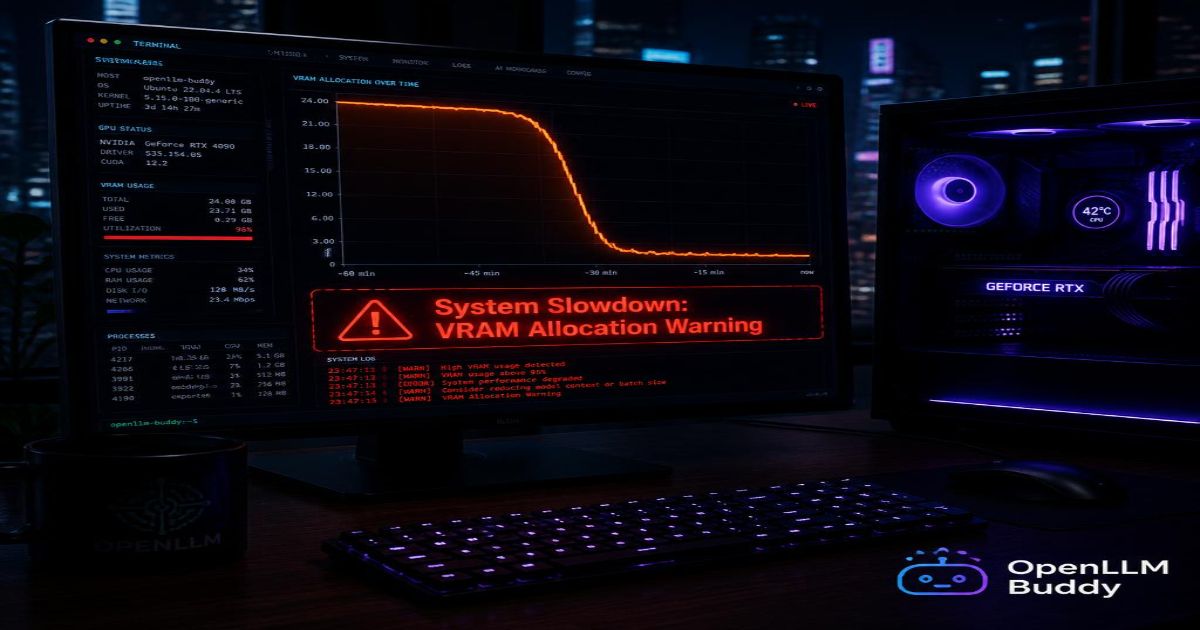
Idle VRAM waste. Your developers ship code at 6 PM and go home. Your GPU instance runs all night at full hourly cost, processing zero requests. There is no "pause" on a bare instance. You pay for the silicon whether it's thinking or sleeping.
Teams that escape Token Anxiety by going self-hosted often land in DevOps Overhead Anxiety — a different kind of dread, equally effective at killing innovation. Instead of watching the token counter, you're watching the incident board at 2 AM because your MoE routing config caused an OOM crash on the inference server.
You traded one constraint for another.
4. The Cure: Predictable Compute with OpenLLM Buddy
OpenLLM Buddy was built to break both traps simultaneously.
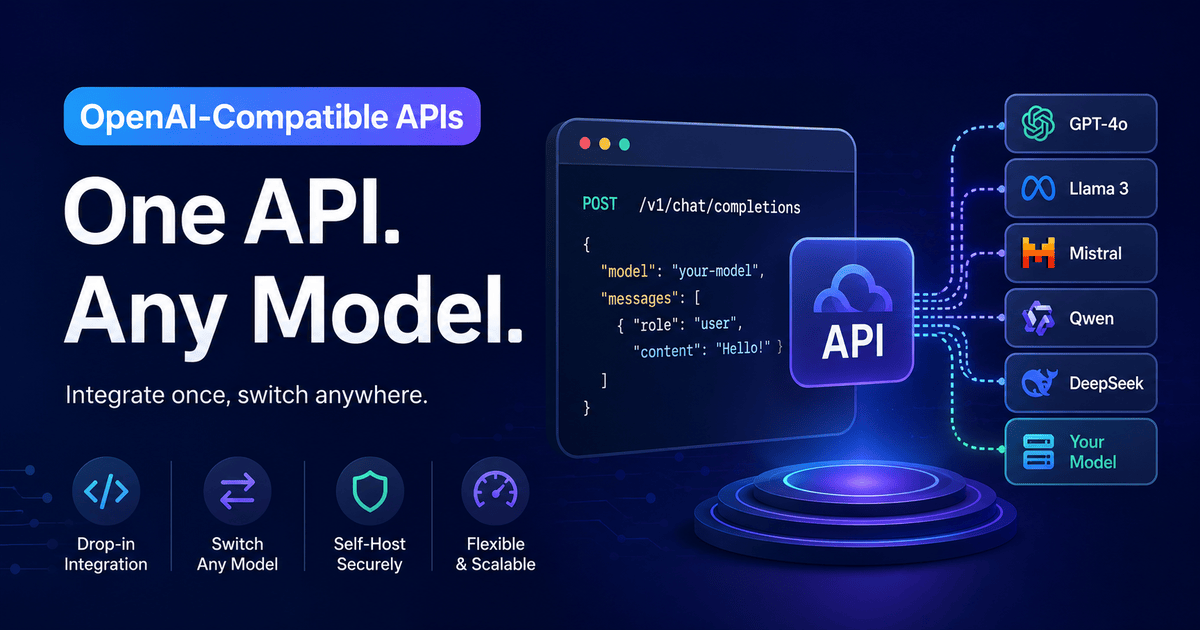
The platform completely decouples your AI features from per-token pricing by providing dedicated, production-ready API endpoints backed by NVIDIA RTX 4090 and next-generation RTX 5090 hardware clusters running on high-efficiency RunPod compute. The MoE orchestration, the KV cache management, the expert routing optimization — all of it is handled at the platform level. You get a clean, OpenAI-compatible base_url and nothing else to configure.
The core value proposition is simple: token consumption is 100% free. You pay only for raw GPU compute time.
No input token charge. No output token charge. No thinking token charge on agent reasoning loops. No surprise invoice because a context window grew larger than your estimate.
No more metered breathing room. Run a 200,000-token codebase analysis, let an autonomous agent loop hundreds of times overnight, or test twenty different system prompts simultaneously. Your billing remains bound strictly to the minute-by-minute runtime of the silicon, giving your team the absolute freedom to build without financial paralysis.
The pricing is flat and predictable:
| Plan | Gemma 4 26B (RTX 4090) | Qwen 3.6 27B (RTX 5090) |
|---|---|---|
| 11 Hours | $10 | $14 |
| 24 Hours | $22 | $31 |
| 1 Week | $150 | $212 |
| 1 Month | $599 | $845 |
Both plans auto-terminate on uptime quota — no idle overnight billing. You're only paying when the silicon is actually working for you.
The migration from any existing OpenAI-compatible stack is a single line:
from openai import OpenAI

# Before: bleeding tokens on every reasoning step
# client = OpenAI(api_key=os.environ["OPENAI_API_KEY"])

# After: flat compute, zero token charges
client = OpenAI(
    base_url="https://your-openllmbuddy-endpoint/v1",
    api_key="not-needed",
)
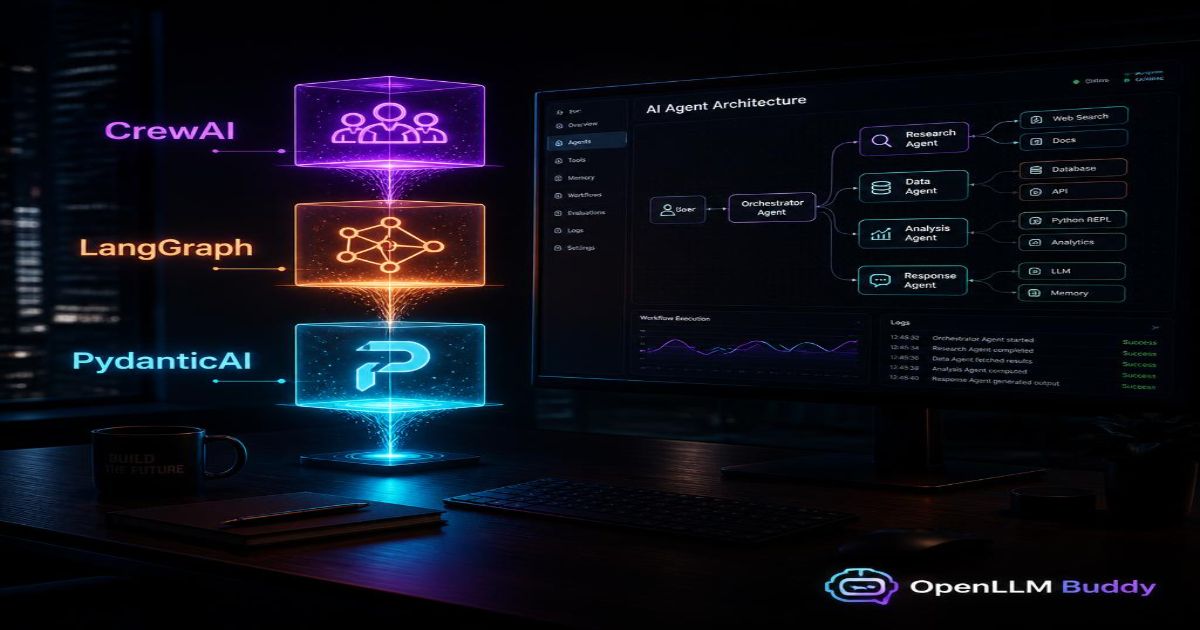
LangChain, CrewAI, AutoGen, n8n — same swap, every framework. Your agent logic, your prompts, your tooling — unchanged. Just a different endpoint and a fundamentally different cost structure.
Stop Optimizing for Tokens. Start Building for Users.
Token Anxiety is a product of the infrastructure you chose, not an inherent condition of building with AI. The best product decisions — the longer context, the deeper reasoning loop, the twentieth iteration of a system prompt — should never be filtered through a mental per-token cost calculation.
Your competitors who solve this first will ship faster, iterate more freely, and build better products. The infrastructure gap between "anxious and metered" and "free and flat-rate" is now one base_url away.
Migrate your API infrastructure to OpenLLM Buddy today. Claim your predictability. Build without the dread.