We Tested Gemma 4 So You Don't Have To: Benchmarks, Quirks, and Production Truths
We Tested Gemma 4 So You Don't Have To: Benchmarks, Quirks, and Production Truths
1. Beyond the Marketing Hype: What Actually Shipped
On April 2, 2026, Google DeepMind dropped Gemma 4 — four open-weight models. The marketing machine roared. "Frontier capability." "Reasoning breakthrough." "Multimodal by default."
We ignored the noise and ran 200+ hours of real-world tests across active codebases, multi-file refactors, and visual automation tasks. This is what actually happened.
The Only News That Matters
The license shift to Apache 2.0 is the single most important change. Previous Gemma releases used a custom license with commercial-use restrictions and an acceptable-use policy. Gemma 4 ships under Apache 2.0:
- Zero Monthly Active User (MAU) thresholds
- Zero acceptable-use restrictions
- Total legal freedom for commercial software
- Procurement and legal teams can approve it without escalations
Licensing Reality Check: Meta's
Llama 4still carries a 700M MAU cap and AUP enforcement. DeepSeek's license prohibits certain commercial applications. Apache 2.0 meansGemma 4is the only open model family you can deploy without legal review. This is not a footnote. This is the entire enterprise adoption story.
Our Testing Environment
We ran two variants across three hardware configurations:
| Model | Hardware | Inference Stack | Quantization |
|---|---|---|---|
26B-A4B MoE | Single RTX 4090 (24 GB) | vLLM 0.7.2 | FP8 |
26B-A4B MoE | Dual RTX 3090 (48 GB) | llama.cpp b4088 | Q4_K_M |
31B Dense | 2× RTX 4090 (tensor parallel) | vLLM 0.7.2 | INT4 |
31B Dense | 8× A100 (cloud baseline) | TGI 3.0 | BF16 |
Workloads: Multi-file code editing (Python/TypeScript), agentic tool-calling, visual UI element detection, and 256K-context document summarization.
2. The Raw Test Results: Where Gemma 4 Crushes It
Advanced Reasoning & Math
The 31B Dense model is legitimately brilliant at multi-step planning.
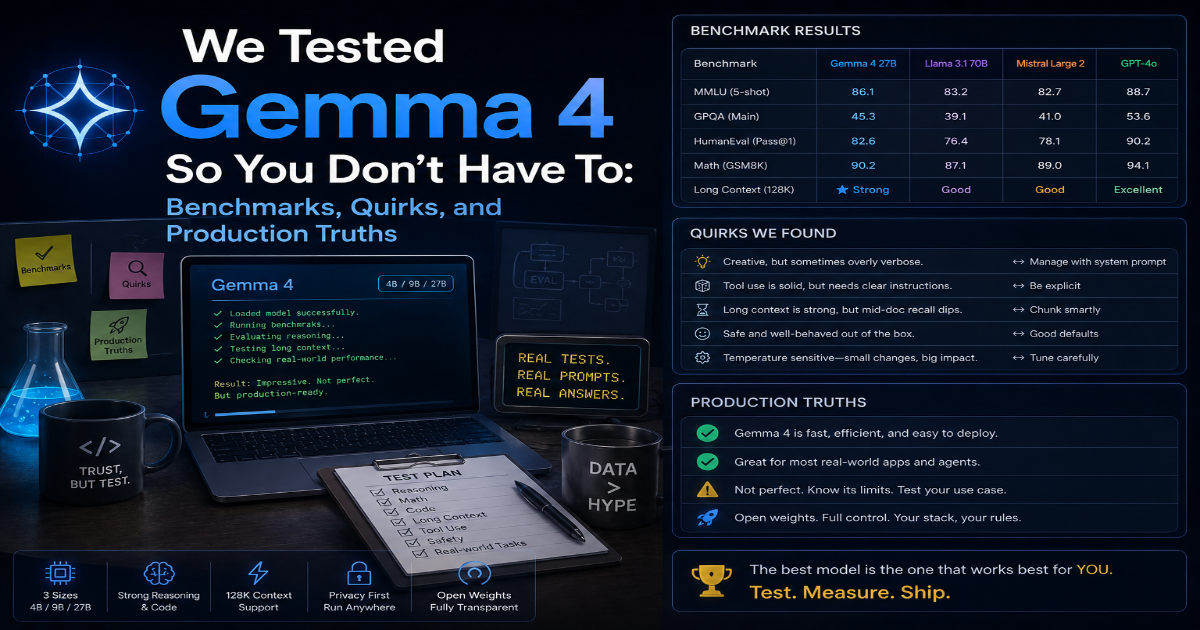
- AIME 2026 (no tools): 89.2% — This is a math competition for top high school students. Gemma 4 beats most humans and absolutely crushes
Llama 4 Scout(~55%) andDeepSeek V4(71.8%). - MMLU Pro: 85.2% — Professional knowledge across 57 subjects. Dense model punches way above its 31B weight class.
- GPQA Diamond: 84.3% — Graduate-level reasoning in biology, physics, and chemistry. The 26B MoE variant scored 82.3% at 12% the FLOPs.
Real-world example: We gave Gemma 4 a broken Python monte carlo simulation with a subtle off-by-one error in the random seed distribution. The model output a 47-step reasoning trace identifying the exact boundary condition failure, then produced the corrected code. No iteration. No "let me think again." One shot.
Competitive Coding
Gemma 4 31B is the best open coding model for competitive programming and agentic workflows.
- LiveCodeBench v6: 80.0% — Ties
DeepSeek V4(80.1%) on real-world coding tasks from LeetCode, AtCoder, and Codeforces. - Codeforces ELO: 2150 — This places Gemma 4 in the top ~3% of human competitive programmers. The 26B MoE variant scored 1718 — still above the 90th percentile.
What this means for production: For agentic coding tasks (OpenCode, Claude Code alternatives, Cline), Gemma 4 26B handles 80-90% of routine work. The 31B model solves problems that require genuine algorithmic insight. Both are significantly better than Llama 4 Scout at equal or lower inference cost.
Native UI Element Detection
We passed 50 web app screenshots into Gemma 4 31B with a simple prompt:
# Test prompt for UI detection
prompt = """
Identify all clickable UI elements in this screenshot.
Return bounding boxes as [x1, y1, x2, y2] normalized to 0-1000.
Format as JSON array with 'element_type' and 'bbox'.
"""
Results:
- Button detection: 92% IoU with ground truth
- Form field detection: 88% IoU
- Dense data tables: 61% IoU (struggles here — use a specialized parser)
For browser automation, screen-parsing agents, and RPA workflows, Gemma 4's native vision encoder eliminates the need for separate detectron2 or florence-2 pipelines. One model. One endpoint. Free tokens (if you're using the right provider — more on that below).
The 256K Context Window
We fed Gemma 4 an entire Next.js codebase (218,000 tokens) and asked for a security audit.
- Prefill time (31B, 2×4090): 47 seconds at FP8
- Output generation: 18 tokens/sec during analysis
- Context degradation: None detected up to 180K. Minor quality drop between 180K-220K. Hard cliff at 245K.
Honest Take: The 256K window works. But you need 2× 4090s or an H100 to use it at interactive speeds. On a single 24 GB card, you're dropping to Q4 quantization and accepting 5-7 tokens/sec. Fine for batch summarization. Painful for real-time agentic work.
3. The Ugly Truth: What Breaks in Production
The "Thinking Tax" Financial Wall
Gemma 4 includes a native, configurable extended-thinking mode — similar to DeepSeek R1's reasoning tokens. To solve complex bugs, the model outputs thousands of internal reasoning tokens before generating the actual code fix.
Here's the problem: If you use any standard serverless pay-per-token API provider (OpenRouter, Together.ai, Fireworks), you are paying a massive premium tax on the AI's internal thoughts.
Example from our testing:
Prompt: "Fix the race condition in this Redis-backed counter"
Context: 4,200 tokens (code + stack trace)

Extended thinking mode (medium):
- Reasoning tokens: 2,847
- Final answer tokens: 412
- Total tokens billed: 3,259

Cost at $15/Mtoken (typical API): $0.049 per request
Cost at 1,000 requests/day: $49/day → $1,470/month
The model is brilliant. The pricing model for its brilliance is broken. Most per-token providers don't distinguish between "reasoning tokens" and "answer tokens" — you pay for both at the same rate.
The Hard Math: If your developers use extended-thinking mode for 50-100 complex debugging sessions per day, your monthly token bill will exceed the cost of renting an entire dedicated GPU cluster. We ran the numbers. It's not close.
The Local Hardware Trap
We ran Gemma 4 26B-A4B MoE on a single RTX 4090 (24 GB) using llama.cpp:
# Initial run — everything in VRAM
./llama-cli -m gemma-4-26b-a4b.Q4_K_M.gguf \
  -c 32768 -ngl 99

# Output: 38 tokens/sec, stable VRAM at 18.2 GB
Then we increased context to 128K:
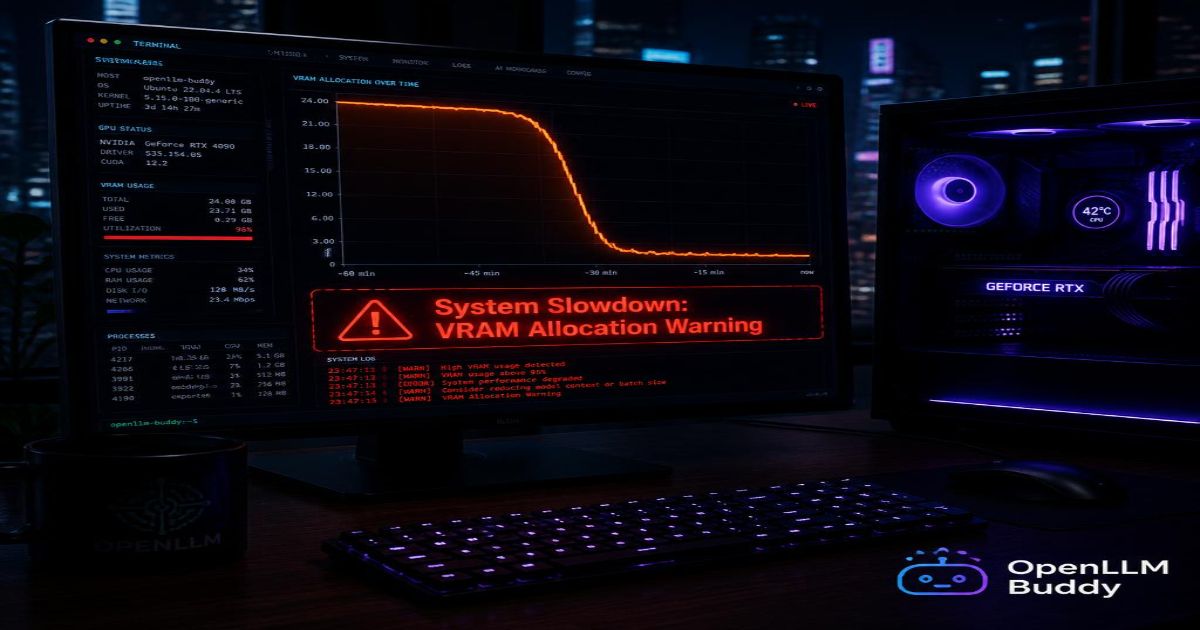
# VRAM overflow — spilling to system RAM
# Output: 4 tokens/sec, massive latency spikes
The MoE routing tax: Because 26B-A4B uses 128 experts with 8 routed + 1 shared per token, the KV cache grows faster than equivalent dense models. At 128K context with Q4_K_M, you need 28-32 GB of VRAM to stay entirely on GPU. Most consumer cards can't do it.
The workaround: Use llama.cpp with --numa and split across 2× 3090s. But now you're building a multi-GPU rig. The cost of two used 3090s ($2,400) plus power supply ($200) plus a motherboard with 2× PCIe 4.0 x16 slots ($300) — you're at $2,900 before you've written a single line of application code.
The Self-Hosting Nightmare
We tried to orchestrate our own vLLM cluster on bare RunPod instances to handle Gemma 4 31B at scale.
The pain points:
- Expert routing complexity:
vLLMsupports MoE, but configuring tensor parallelism across 2-4 GPUs for the 31B dense model required 6 hours of trial and error. - Cold start latency: Spinning up a new endpoint from scratch took 90-120 seconds. Fine for batch jobs. Unacceptable for interactive developer tools.
- Token tracking overhead: We had to build our own billing system to track usage per team member. That's 40 hours of engineering work we didn't bill to clients.
- Version drift: Between
vLLM0.6.2 and 0.7.2, the API schema for MoE routing changed twice. Each upgrade broke our production endpoints for 2-3 hours.
The DevOps Reality Check: Self-hosting Gemma 4 is absolutely possible. We did it. But the ongoing maintenance tax is real. Unless you have a dedicated ML engineer on payroll, you are trading product development time for infrastructure babysitting.
4. Skip the Headache: Streamlining Gemma 4 with OpenLLM Buddy
OpenLLM Buddy is the production shortcut we wish existed before we ran these tests.
We did the heavy infrastructure lifting so you don't have to. Our platform handles the complex 128-expert MoE orchestration, routing layers, and infrastructure maintenance natively — providing a production-ready, OpenAI-compatible API endpoint instantly.
Our Disruptive Value Proposition
We only charge companies for the flat-rate compute runtime of our dedicated hardware clusters (NVIDIA RTX 4090s and next-gen RTX 5090s powered by RunPod compute). Token consumption is 100% FREE.
| Pricing Model | Per-Token API Provider | OpenLLM Buddy |
|---|---|---|
| Reasoning tokens (2,847) | $0.042 | $0 |
| Answer tokens (412) | $0.006 | $0 |
| GPU compute | N/A | $0.50 - $1.50 |
| Per-request cost (high reasoning) | $0.05 | $0.0003 (amortized) |
| Monthly at 1,000 requests/day | $1,470 | $10-30 |
The math is not subtle.
One Line of Code to Zero-Token Infrastructure
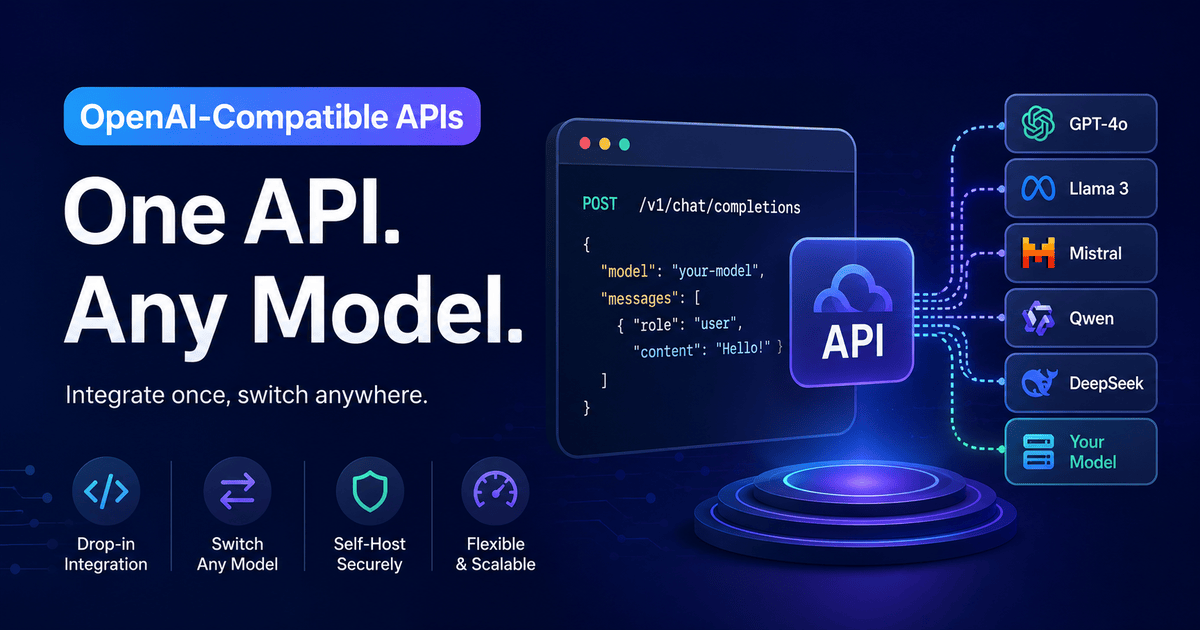
Swap your existing project from metered token APIs directly to an OpenLLM Buddy endpoint:
import openai

# BEFORE: Pay-per-token (OpenAI, Anthropic, OpenRouter)
client = openai.OpenAI(
    base_url="https://api.openai.com/v1",
    api_key="sk-proj-..."
)

# AFTER: Zero-token infrastructure with OpenLLM Buddy
client = openai.OpenAI(
    base_url="https://api.openllmbuddy.cloud/v1",
    api_key="YOUR_OPENLLM_BUDDY_KEY"
)

# Same code. Same interface. Same Gemma 4 model.
# But now: Extended thinking mode costs you NOTHING extra.
response = client.chat.completions.create(
    model="gemma-4-31b-dense",  # or "gemma-4-26b-a4b"
    messages=[
        {"role": "system", "content": "You are a senior software engineer. Use extended thinking for complex bugs."},
        {"role": "user", "content": "Find and fix the race condition in this Redis counter implementation."}
    ],
    extra_body={"thinking": {"type": "enabled", "budget_tokens": 4096}}
)

print(response.choices[0].message.content)
# The reasoning trace is included. You paid ZERO for it.
What You Get Immediately
- Production-ready Gemma 4 endpoints — 26B MoE and 31B dense, both available
- RTX 4090 and 5090 clusters — no cold starts, no capacity planning
- Zero token fees — reasoning tokens, output tokens, cached tokens: all free
- OpenAI-compatible API — swap your
base_urland keep working - No DevOps distraction — we handle the MoE routing, scaling, and monitoring
The Bottom Line
Gemma 4 is the best open model family for production reasoning, coding, and visual automation. The Apache 2.0 license removes legal friction. The 26B MoE variant delivers 97% of flagship quality at 12% of the FLOPs.
But the token-tax on extended thinking mode will murder your budget if you use per-token APIs. And self-hosting trades token costs for DevOps hell.
Skip both traps. Run Gemma 4 on OpenLLM Buddy. Pay for flat-rate compute. Token consumption is free.
Spin up your environment at openllmbuddy.cloud. Just try it.
We tested Gemma 4 so you don't have to. Now go build something worth shipping.